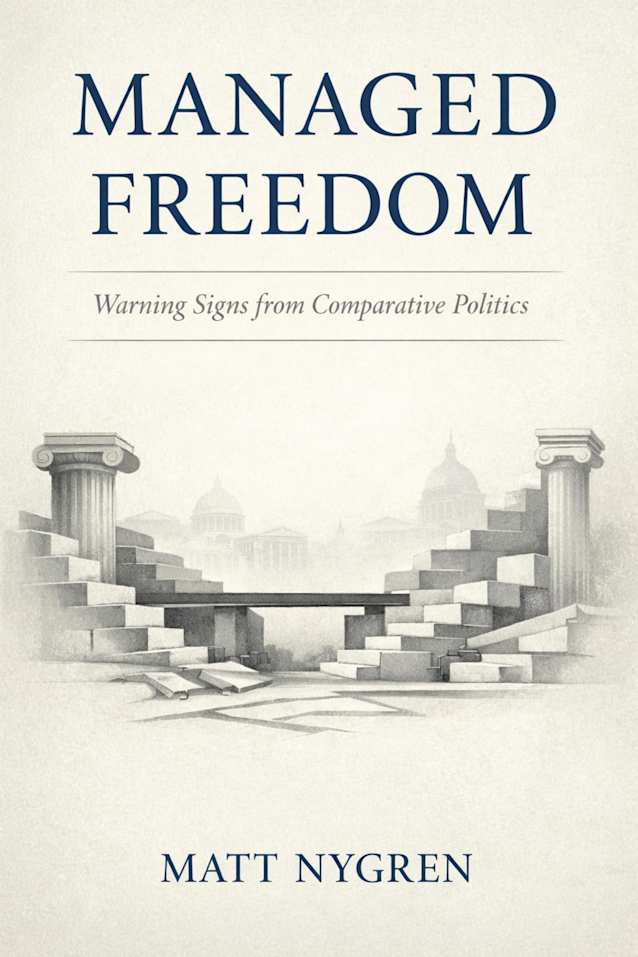
Managed Freedom: Warning Signs from Comparative Politics
About
Managed Freedom: Warning Signs from Comparative Politics
Managed Freedom: Warning Signs from Comparative Politics examines how democratic systems can weaken gradually—often without breaking laws, canceling elections, or announcing collapse.
Rather than focusing on personalities or headlines, the book traces how ordinary decisions, repeated over time, can quietly change what democratic power feels like in everyday governance.
Drawing on decades of comparative political research, the book explores a pattern observed across multiple countries: democratic erosion rarely arrives through sudden rupture. More often, it unfolds through lawful procedures, familiar rhetoric, and incremental shifts in institutional behavior. Elections continue. Courts operate. Formal rules remain intact. Yet democratic practice grows thinner.
Using Hungary as a baseline comparative case, Managed Freedom shows how a country can move away from liberal democracy without abandoning electoral legitimacy. That case is then placed alongside the United States, examined carefully and without exaggeration, to ask a narrower and more defensible question: which warning signs identified in comparative research appeared, and how did American institutions respond?
Across its chapters, the book analyzes:
- The illusion of electoral mandate
- The delegitimization of institutional referees
- The reclassification of the press as a political adversary
- The rise of personalism over party restraint
- Emergency framing without clear end points
- Lawful governance that weakens liberal constraint
- Loyalty pressures within administrative institutions
- Why resistance often slows erosion without fully reversing it
Throughout, the analysis avoids claims of inevitability, intent, or conspiracy. It does not argue that democracy disappeared, nor does it predict future outcomes. Instead, it treats warning signs as diagnostic tools—indicators of stress rather than declarations of failure.
The central argument is deliberately modest and comparative: democracy is not undone by illegality alone, but by normalization. It weakens when practices once treated as extraordinary become routine, when restraint is reframed as obstruction, and when institutions lose legitimacy even as they retain authority.
Written from the perspective of a political science scholar, Managed Freedom is designed to be accessible to general readers while remaining grounded in academic research and comparative method.
This book is suitable for undergraduate and graduate courses in political science, comparative politics, democratic theory, and institutional analysis. It is intended for educational use and scholarly discussion.