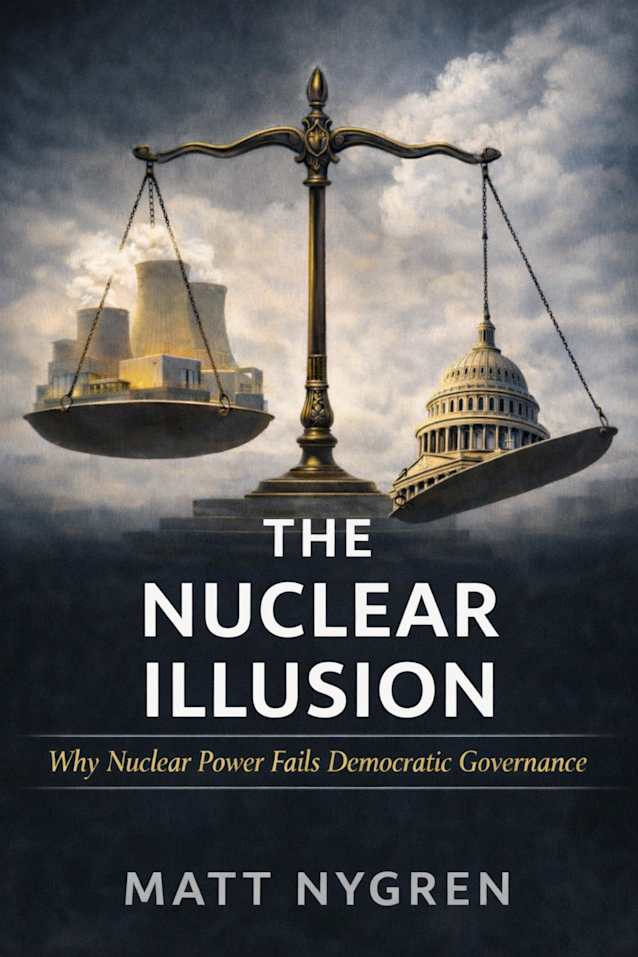
The Nuclear Illusion: Why Nuclear Power Fails Democratic Governance
About
NUCLEAR POWER IS OFTEN FRAMED AS UNAVOIDABLE.
Too important to question. Too urgent to refuse.
The Nuclear Illusion challenges that assumption by examining nuclear power not as a technical solution, but as a system of governance. Rather than asking whether nuclear energy can work in theory, this book asks what happens when a technology requires permanent exceptions in order to function.
Across energy policy, public finance, safety regulation, waste management, and national security, nuclear power repeatedly demands special treatment. Liability is capped rather than fully absorbed. Markets are supplemented rather than trusted. Security obligations persist without clear endpoints. Long-term risks and costs are shifted forward, binding future institutions to decisions made under present urgency. These demands are not anomalies. They are structural features of how nuclear power operates within democratic systems.
The argument of this book is not that nuclear power fails catastrophically. It fails quietly. It absorbs institutional capacity, narrows future options, and converts short-term urgency into long-term obligation. Governance systems designed around revision, accountability, and reversibility become strained by technologies that depend on continuity without end. The result is not collapse, but constraint.
The Nuclear Illusion then turns to the energy transition already underway. Renewable energy, storage, and modern grid coordination outperform nuclear power not by scale, but by institutional fit. They deploy faster, adapt more easily, tolerate error, and remain governable over time. These systems align with how modern democracies actually function, rather than how they are imagined to function under ideal conditions.
This is not an argument for inaction, nor a rejection of decarbonization. It is an argument for restraint. It asks whether expanding systems that require permanent exception is compatible with democratic governance, especially under climate pressure and political fragmentation.
Written for readers interested in energy policy, public administration, political science, and democratic accountability, The Nuclear Illusion offers a sober, non-ideological examination of why some technologies persist long after their logic has eroded. At its core, the book argues that when a system can function only by standing apart from ordinary accountability, the cost is not only financial or technical. It is institutional.
The question is no longer whether nuclear power can be maintained. It is whether maintaining it crowds out better choices.